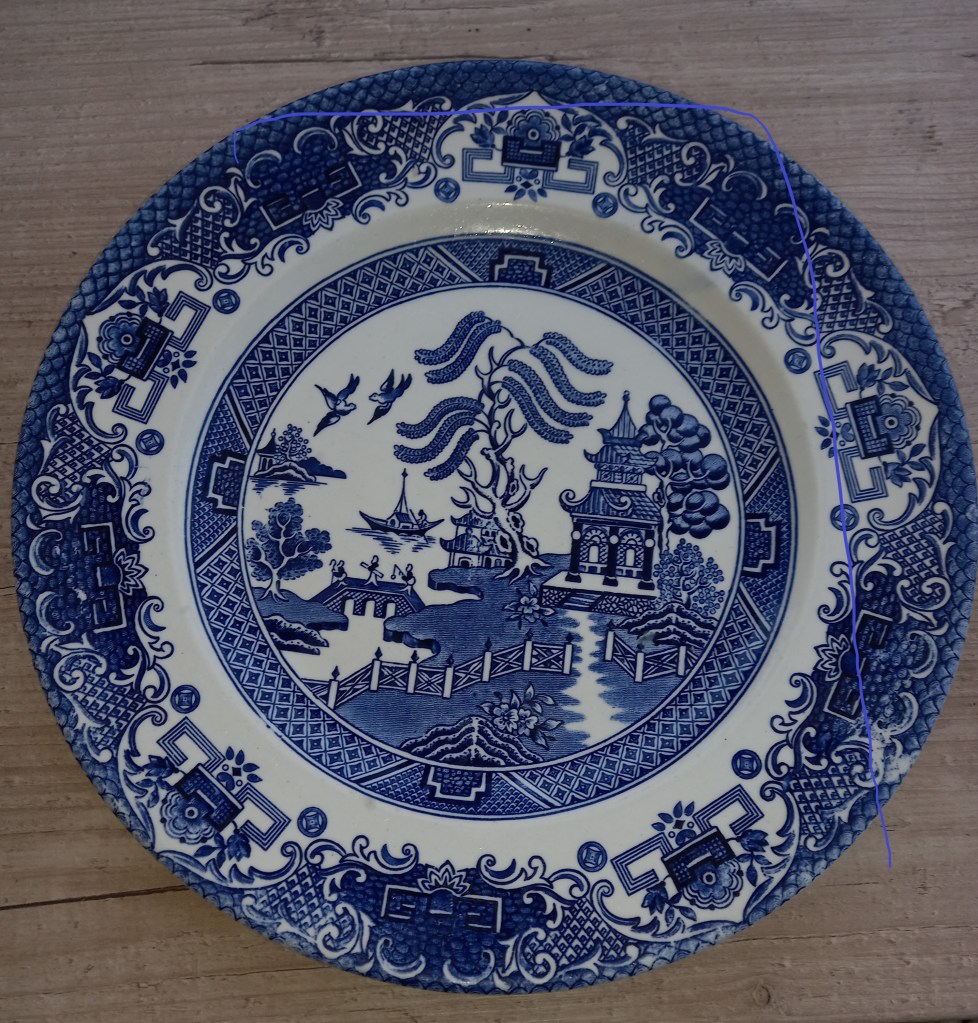
I’m fortunate enough to own a beautiful bone china coffee service: it’s almost 100 years old and though it’s too fragile to use, seeing it every day gives me great pleasure. The next oldest item of china I’ve got is a plate decorated with the famous Willow Pattern, which I found abandoned on a kitchen shelf when we moved into a previous home over forty years ago.
It’s an ‘everyday’ plate which must have been quite cheap to buy. It may be the only remnant of a tea set; I will never know. I’m surprised simply at how long it’s stayed intact, as my husband has eaten his sandwich lunch from it on most days for over forty years.
I wash up and put away the plate every day with barely a glance. However, I did stop and look at it more closely recently and was struck by the image of the small bridge leading from the left of the main part of the scene towards another place which is almost out of sight.
In the fairy story which inspired the pattern, Koong-Se and Chang, a young couple whose marriage has been forbidden, escape over a bridge but are followed subsequently and killed and then immortalised in the form of the doves seen flying over the scene.
This got me thinking about the reasons why we have bridges and how they can be considered in the context of prayer.
Bridges are built in straight lines generally, with strong supporting pillars and, often, anchor points at either end. Many remain standing centuries after they were built. For example, the bridge at Postbridge on Dartmoor in Devon, built in mediaeval times for pack horses to carry tin from local mines to the town of Tavistock. Some cross water, carrying road or rail traffic above rivers or harbours to connect places and communities.
Often a bridge is the shortest and most direct route between two places and when a bridge is destroyed, whether during a conflict or because of a natural disaster such as flooding, the journey between the places which have become separated can be a time-consuming and frustrating process.
Prayer is a bridge between us and God, not dividing us but linking us. However challenging prayer can be at times, and it can sometimes feel as though we’re crossing very choppy waters, prayer carries us safely to the heart of God.
The prayer bridge is always open and there’s no toll to pay before we’re allowed to cross. Jesus paid that toll for us on his cross.
Another bonus is that prayer isn’t restricted to a particular time or place. We can pray anywhere and everywhere: in formal settings such as during a church service or while walking round the supermarket or around local streets with a dog, for example.
I’ve had some really good prayer times when I’ve prayed aloud quietly under my breath whilst driving, though with the current state of many of our roads, I will only do this on roads that I know very well, at times when traffic levels are low and during the daytime so that I can remember (usually!) where all the potholes are.
Walking around our gardens or across the countryside on a sunny day is a beautiful setting for prayer too of course and prayer can come very easily and naturally then. These are the times when the bridge of prayer is crossing calm waters.
Sometimes though, we go through turbulent, challenging, even dangerous times in our personal lives when it’s hard to see a clear way forward. We have to cross some choppy waters. That’s when our bridge of prayer, however weak and wobbly and like a personal Bridge of Sighs it feels, is at its strongest, withstanding the most agonised outpouring of pain and doubt and anchoring us to the firmest of foundations.
We can build bridges for other people too. As we lift them to God and ask that he will carry them safely from one side of a difficult situation, via our prayer bridge, to an acceptance or resolution of the things which are troubling them, they may be encouraged to repair, maintain, strengthen, or even build for the first time their own bridge to God’s heart.
Yes, we all need to maintain our prayer bridges carefully: that work continues throughout our lives. However many times the ground beneath our feet feels unsteady and however often we feel in fear of being swept away, unlike Koong-Se and Chang in the story told by the Willow Pattern, we know that at the end of our lives our prayers will be answered as we cross that final bridge to reach a place of complete safety with God.
Covering bridges with padlocks to symbolise love between people is common in many places, though the padlocks will rust eventually. Bridges built with prayer aren’t visible, though their effects may be, and if we look after them, they won’t fail. What maintenance does your bridge need today and whose lives might you padlock to it in love?
 Sunlight Through the Shadows
Love this analogy Sherrian, thanks again. I was reading more on this theme this afternoon too!
LikeLike