The Wonder in the Waiting

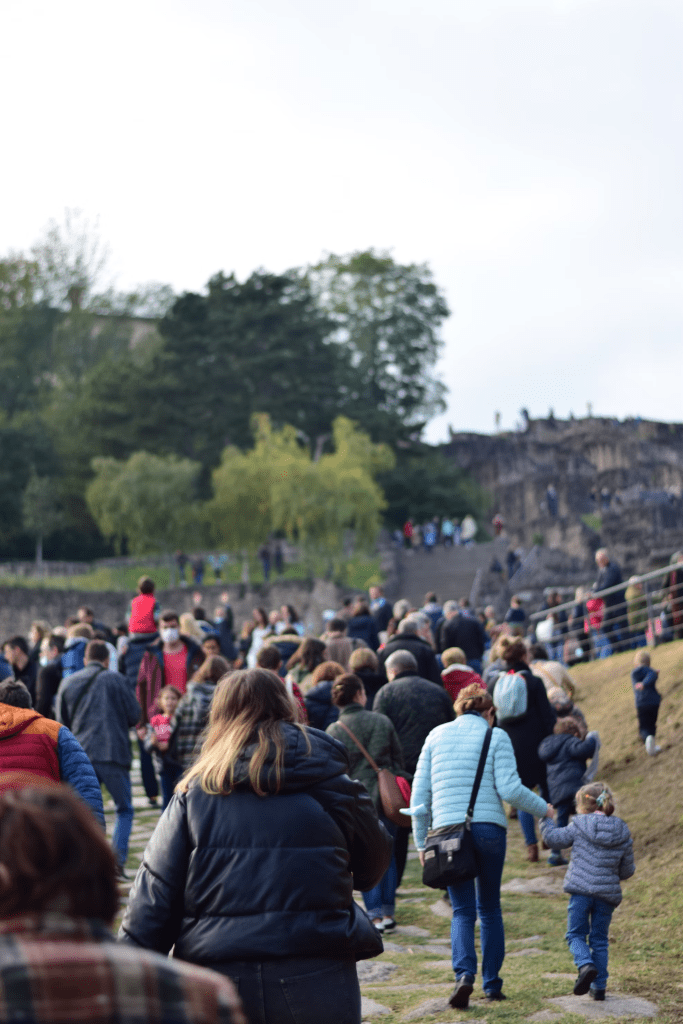
Image by Manuelthelensman@Unsplash.com

As I write, I’ve just finished two weeks serving as a juror at a local county court. It came at a particularly difficult time of year for me, as I tend towards slight depression during the shortest days of the year. I’m also recovering from a nasty fall and have managed to pick up a cold as well!

I’ve been called to do jury service on two previous occasions. Though some things have changed since my previous experience about twenty years ago, such as the use of CCTV and doorbell camera footage as evidence, some things don’t seem to have changed.

As before, so much of my time was spent waiting: waiting for trains and buses to get me to court; waiting to be allocated to a case; waiting for all the members of the jury I served on to arrive each day; waiting for the judge and barristers to deal with legal matters before we could start the day’s business and waiting for the kettle to boil so the jury could make a hot drink whilst deliberating.

Some of the waiting involved uncertainty: I wondered whether the delayed train link with a bus to get me to court on time? Would we be called into court punctually or have to wait for another long period in not particularly comfortable surroundings? Would my ‘early lunchtime’ loving stomach betray me in the quiet of the courtroom as the case moved past midday?

Normally during Advent I’m able to take time for reflection, often using daily readings from an Advent themed book. This year, unfortunately, I’ve been so exhausted, both physically and mentally, that I’ve experienced hardly any peaceful reflection in this pre-Christmas season. Instead, my progress through Advent has been dogged by frustration, ill health, stress …. and waiting.

Yet, I sometimes found myself thinking of other people who were waiting at the same times as me but in different situations. For example, those in hospitals, waiting for operations or procedures to start, people waiting anxiously for news of missing relatives, or for a legal transaction to be completed, others waiting for someone to reach the end of their life or for a baby to be born.

Then my thoughts turned to Mary. Her waiting put my own firmly into perspective and I started to see it differently. I realised that mine was accompanied at times by resignation rather than expectancy, and much frustration as the justice system ground through its own time frame and the days dragged on.

She waited for her baby to be born, trustingly, with anticipation, joy, excitement and wonder though, perhaps naturally, with some physical pain and trepidation too.

As is the case with any trial, the lives of those directly involved in the one I took part in, together with their families and friends, may be altered forever in various ways. They may not appreciate how that will unfold, yet, and have more waiting to come.

I’m sure that Mary bore her situation much more patiently than I’ve borne all the waiting of the past two weeks. Even though she couldn’t comprehend the full significance of her son’s birth and how the story of human history would be changed forever as a result. Now that I have time for reflection, I realise that I need to pray for grace to wait patiently, whatever circumstances I find myself in and re-engage with the wonder and awe of the coming of God into our world as a human child.

As we enter the final few days before Christmas, wondering how we’ll fit in all the final bits of shopping and other chores and where those promised deliveries have got to, let’s pause when we can. Pause to remember the outcome of Mary’s patient acceptance of her great commission to carry the son of God to his first coming and pray for grace and patience as we wait trustingly, with anticipation, wonder and excitement for his second coming.

Have a peaceful, blessed and wonder-filled Christmas.

Christmas Shopping

Picture by Getty Images from Unsplash.com

This week, the third week in November, is always special to me as it brings back wonderful memories. Memories of travelling to London with my mum over so many years for our annual Christmas shopping day, always on a Thursday, when many of the large stores were open later than usual.

We’d travel to Oxford Street in the heart of London. Step counting technology wasn’t around then, but I know we exceeded not one but many days’ step targets as we trekked the length of the street and back again, first admiring the beautiful window displays then venturing inside to buy gifts, decorations and wrappings. Still a month before Christmas, the stock in the shops looked new and fresh and even as adults, we felt a sense of excitement and wonder.

By the end of the day, as daylight faded and the Christmas lights above the street came on, we’d stop for a much needed drink and rest before taking the train home, laden with parcels. Now, many years later and as this year’s Christmas adverts begin to appear on television again, I feel very nostalgic for those special days.

Christmas shopping is very different for me now. I don’t have many gifts to buy as the family has shrunk over the years and its few younger members appreciate having vouchers and being able to choose clothes from whichever stores are trending currently.

However, this year I’ve been summoned for jury service for the middle two weeks of December so I’m trying to buy those vouchers, write and post Christmas cards and plan three weeks of meals within a very short space of time. I’ve often felt overwhelmed with everything, as I had a fall recently and am trying to recover from that too.

It feels as though I’m just rushing through my days and weeks towards the end of the year. I need to stop, take a breath and remember that Advent begins next week. Advent …. the season of preparation …. and waiting.

It’s usually a season I enjoy: not, these days, marked by the Advent calendars of childhood, but with an Advent book full of daily readings to explore and reflect on. At the moment I feel that I’ve concentrated too much on Christmas preparation and have been neglecting the reflective, waiting time.

Perhaps you feel the same? It’s so easy to get caught up in the momentum of everything. As the weather has turned colder this week and, in some parts of England there has been snow, I’ve felt a bit like a snowball hurtling downhill, collecting more and more layers as I travel. If I’m not careful, I shall hit a bump and do myself as much damage as my fall did.

Today, I’m taking stock and reminding myself that I don’t need to, and indeed, can’t, do everything in my own strength. I need to remember to lean into the Lord, knowing that He will take my burdens and walk ahead of me through this ‘just pre-Advent’ season of the year.

I’m confident that I’ll be guided gently towards the most appropriate Advent reading material, which I can use as a fruitful way to pass the inevitable waiting around time involved in jury service. I’m excited to see where I notice His face in that of other people and His justice in the court procedure.

I still hold dear those lovely memories of Christmas shopping from Novembers gone by, but as for that other festive treat which I’ve always wanted to try: ice skating on an outdoor rink, my fall has left me with one black eye already so I won’t be attempting that any time soon!

Enjoy your Christmas shopping, Advent reading and precious time of waiting … take it slowly.

Changing Clothes for Changing Seasons

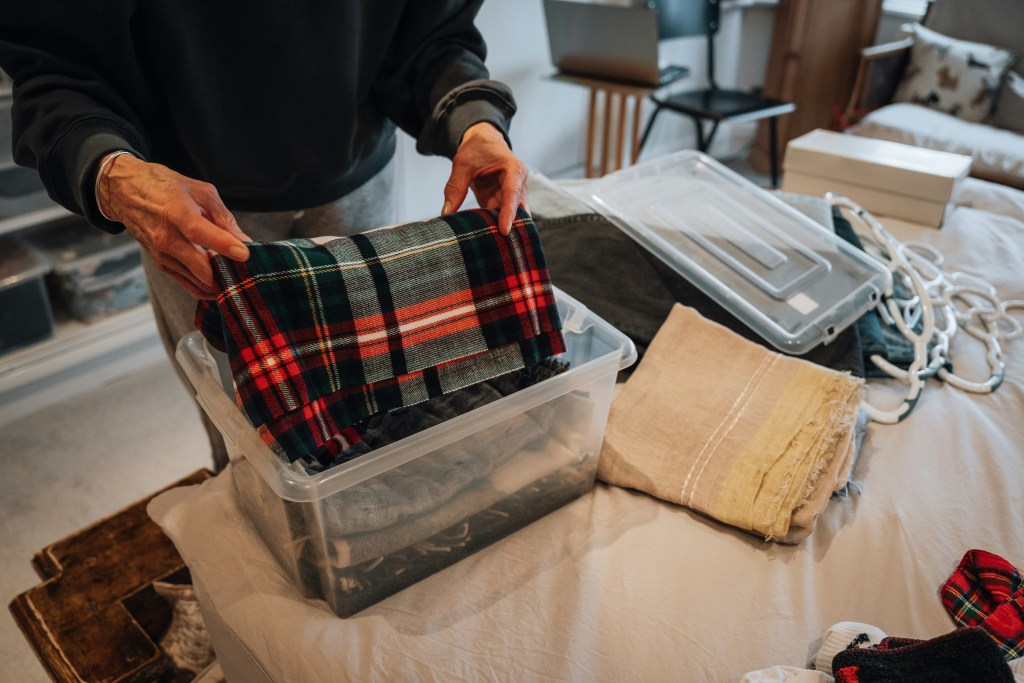
Image by Mesut Cicen at Unsplash

I’m writing this just after the season of International Fashion Weeks in New York, London, Milan and Paris which showcased new ‘looks’ for the Spring/Summer season of 2026. While none of the outfits I’ve seen in the press would either suit or attract me, even if I could afford them, I’ve been reflecting on how we approach the changing of the seasons.  

As well as preparing for the coming months by having an autumn cleaning session (see last post, Clearing Away the Cobwebs for details), I’ve been packing away summer clothes and replacing them with winter ones. This makes me feel sad, because I know that I won’t be wearing shorts or sleeveless dresses and tops again until next Spring.

Yet, as I wash everything, I enjoy remembering some of the special places where I’ve worn particular things: this dress a lovely reminder of a dinner with close friends at the bistro in a favourite hotel; that blouse a holiday purchase and reminder of walking the narrow lanes of shops in the centre of Sorrento in Italy this summer.

Though bringing out the autumn and winter clothes does, sometimes, make me feel a bit miserable as the longer nights draw in, I do like the sense of cosiness which warmer and thicker clothes bring with them.

Also, I invariably come across one or two garments which I’d forgotten I had. One might be an old favourite which I can’t wait to wear again or something I’ve bought but not yet found the right occasion for. Perhaps this winter season will finally bring the occasion when I can wear it. I enjoy particularly, unpacking my small collection of cardigans and sweaters worn for social occasions or at Christmas, one of my favourite times of the year.

At the moment I’m in something of a ‘changeover’ time in my spiritual life too, as I move from being involved in one church community to another and experience a very different style of worship and church community life. It feels strange to be wrapping up one season of life and habits and unwrapping and trying on new ones for size.

I know some, particularly the Holy Spirit filled welcome and sense of joy, will fit me easily while others will need some adjustment and compromise on my part. As I unpack my winter clothes I know I’m clothing a different me to the one who packed them away back in the spring. I’m feeling challenged but excited at the prospect of blending the old with the new in this time of change.

This year’s spring and summer have been beautiful and the autumn a time of great richness in nature, despite ongoing drought conditions. Yet they have also been seasons with periods of unsettling change and loss in so many fields of personal, social, community, national and international life. This new season will, no doubt, see many more challenges.

Sometimes I find it difficult to decide what to wear for these late autumn days when the mornings can be chilly but the afternoons much warmer. It’s good to have a few transitional outfits. I think, sometimes we need ‘between seasons’ times of transition in our lives as well as in our wardrobes.

It’s always good to spend those times considering what we can wrap up and put away, or leave behind completely, as we move forward into the next season of our lives.

All of my clothes, whether appropriate for summer or winter, are made up of threads of some kind. I love having the security of knowing that God’s love is what is weaving the path of my life together and that it is the thread which will never come loose.

So, as I move into the next few weeks, I’m going to embrace the new season and whatever it has to offer me. I’ll never be a catwalk model but I’m happy to look just as God wants me to look and, more importantly, be just as he wants me to be. He will dress me perfectly for every season of my life.

Enjoy your own seasonal switchover. I hope you’ll relive some good times in your memory sparked by what you uncover, perhaps laugh at some of your historic fashion choices and get ready to wrap up for the season ahead …. or unwrap, depending on where in the world you are!

Clearing Away the Cobwebs

We’re just at the start of September, my favourite month, not only for the first sights and scents of autumn but also for the sense of a new beginning, a second ‘new year’ in the calendar.

As children and young people start returning to schools, colleges and universities I look to the next few months as a time of clearing and cleaning, autumn cleaning, reflecting not just the time of year but the season of my life.

The first autumn clean task on my list is a major clean of the conservatory. As I look into it, the first thing I see are the conkers from local horse chestnut trees which I put along the sills every year, having read that they’ll discourage spiders from coming indoors as the weather cools. I’m not sure why I do this each year as I’m neither superstitious nor afraid of spiders. Plus, I can report that it doesn’t seem to work as a deterrent: we have plenty of spiders and their cobwebs all year round.

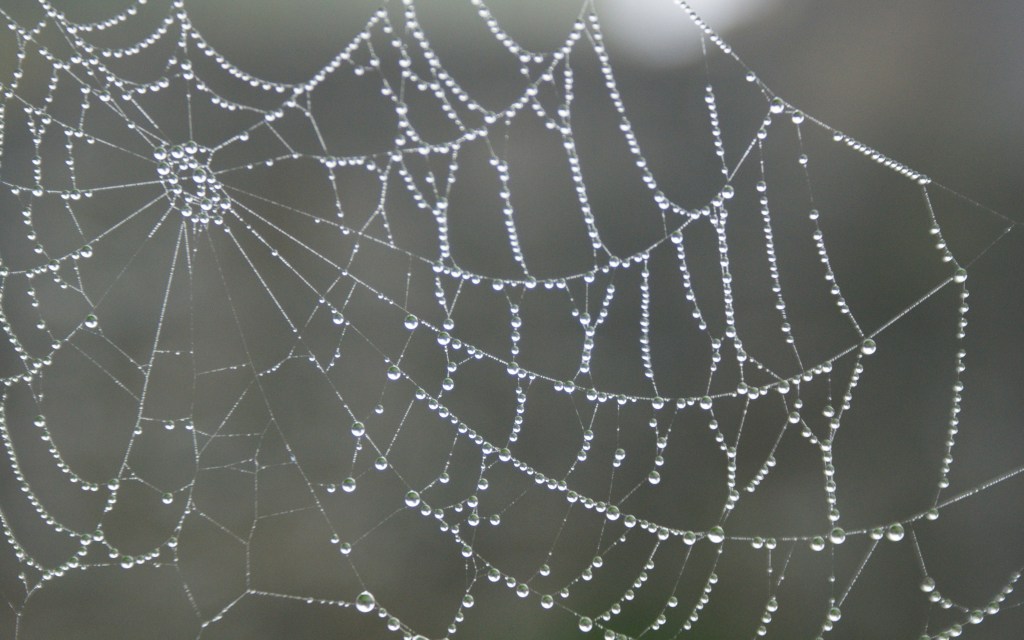
Image by Jan Bullish @ Unsplash.com

Whether you like spiders or are scared of them, there’s something so beautiful about a spider’s web, especially one covered in dew drops like the one in this picture.

Each one is unique, a true gift of God’s creation and takes time to construct. If you don’t have a fear of spiders, it’s fascinating to watch that happen. Think how tiring it must be to knit one, even with eight legs to act as needles!

It’s got me thinking about our individual webs of connections: with family/friends/colleagues/faith groups or through charity work, social groups or sports.

We spend our lifetime being part of webs, spinning and re-spinning them as we move through different life stages. Of course, we don’t always get to choose the webs we’re part of, for example our birth families. Some of the webs we’re part of lead to sadness and conflict; our webs aren’t always as strong as they should be. Unfortunately, our webs may get damaged or even broken completely, leading to great sadness and pain.

Sometimes we spin the wrong people or habits together to try and create a web of security around ourselves or allow things to come into our web which could be harmful to us or for us. Then we discover, like the insects trapped in a spider’s beautiful but deadly web, that they can be very hard to escape from.

When I’m doing my autumn cleaning and removing spiders’ webs with a feather duster, I know that the trickiest bit won’t be reaching up to the highest corners balanced precariously on a stepladder but will be trying to remove the remains of the web from the feather duster. It always takes ages to detach the stickiest bits from my hands.

In our lives too, it can be really hard to detach ourselves from the ‘sticky’ bits, whether they’re bits we’ve chosen or just things we’ve been pulled into. Webs can be so hard to escape from. It’s amazing that something which looks so delicate can be so strong.

If we allow God to draw the various threads of our lives together: those which feel strong, those which feel broken beyond repair; the sticky bits; the abandoned bits; the bits we feel we don’t have the strength to sustain, we can be sure that he’ll take them all and weave them into a spectacular new web, making us not only beautiful but also super strong. He longs for us to allow ourselves to be ‘captured’ by his love.

Part of the wonder of a spider’s web is that light can penetrate it so we can see through it and beyond it. God will show us the beautiful things he has for us and help us to break through to where they are. The things which have trapped us will become easier to shake off as we emerge into a new season.

As we move into autumn with its beautiful colours and scents and sense of a new beginning, let’s celebrate being an essential part of God’s world wide web and let’s pledge to reach out and pull others into its glorious protection.

Filling Our Bowls

On most of the surfaces in the room where I write these blog posts, I have china dishes of all shapes and sizes, many inherited from my mother. Two of these in particular always catch my eye.

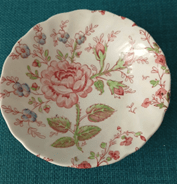
The first is this small round dish with a picture of roses painted inside. I’ve had this dish since I was about six or seven years old. I won it at a fairground.

Each year a visiting fair came to my hometown over a bank holiday weekend and my parents always took my brother and me to visit it. Nowadays, travelling fairs are few and far between and those which do visit where I live now are mostly for children below the age of ten, the tiny roundabouts too big for anyone older.

The prizes for success at one of the many stalls at the fairground were always interesting and, as you can see, of reasonable quality and worth keeping. This dish is now in its sixth decade.

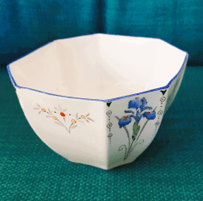
The second favourite among my collection of dishes is actually a sugar bowl. It forms part of a beautiful Shelley fine bone china coffee set decorated with a Blue Iris pattern. This is one I’ve inherited from my mother.

During her early teenage years, she attended a boarding school in rural Hampshire to escape the bombing in her home city of Portsmouth during the second World War. In 1985, She arranged a reunion of former pupils and staff to mark the 40th anniversary of VE Day and then kept in touch with her former headmaster for the rest of his life. The coffee set was a wedding present to him and his wife in 1928 and he left it to my mother when he died. The whole set is quite beautiful and gives me immense pleasure every time I look at it.

The Shelley bowl has a far greater value financially than the fairground bowl, while the fairground one has a direct connection to a childhood memory. Therefore both are equally attractive and precious to me and I’d be very upset if either got damaged.

This got me thinking about the objects (rather than, in this instance, the people) we humans value and how we assess their value. What are the most important things we keep around us? What would we try to save in the event of a fire once our family were safe? Would it be those things which would make it easier to sort out the mess practically and financially as quickly as possible i.e. our insurance policies, identification documents and, of course, the electronic devices without which nowadays we’d struggle to even start the simplest of the processes needed?

Maybe it would be those precious photos of our families, perhaps covering many generations? Wedding photos? Babies’ first shoes or teddy bears? Perhaps, if it were possible, we’d try to save some precious bone china bowls, or simply that misshapen, thumb dented bowl made by a child in their first year at school which has no monetary value but is priceless, nevertheless?

Bowls are such useful things: they can hold all kinds of things, ranging from the sweet like sugar, to the warming like soup. They are always open to receive whatever we need to put inside them.  Perhaps we can think of ourselves as bowls too. Always open to receive what God wants to place inside us.

It doesn’t matter whether we see (or would like to see) ourselves as a piece of delicate bone china or a misshapen and cracked bowl, we are equally priceless to God, who has an interest in us which is lifelong and eternal. It doesn’t matter what size we are; God will continue to make us grow and grow, our lives expanding to take in all he has to offer and all that he’ll pour into us throughout our lives. He’ll repair any cracks or breaks we pick up along the way too if we let him.

Whatever bowls you have in your home and whether they are valuable financially, or sentimentally, your use of them is unique to you, just as you are a unique bowl just waiting for God to fill, in the unique way he chooses to. Perhaps you could let any special bowls you have, be a daily reminder of this ….  but don’t forget to dust them regularly! Or, why not simply make a bowl with your hands each time you pray?

Taking a Dip

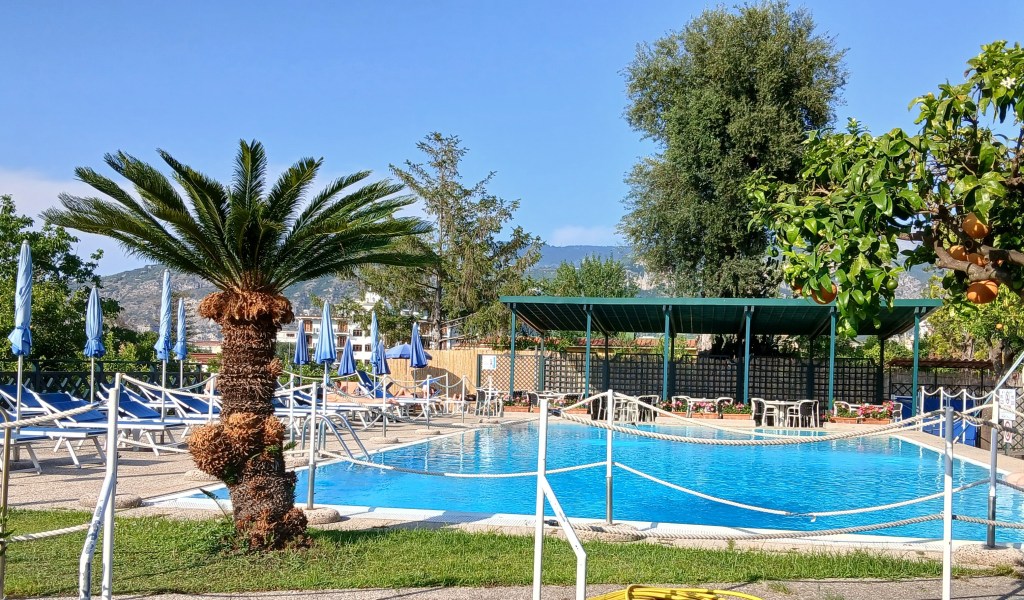
We’ve recently returned from a holiday in Sorrento on the Amalfi coast of Italy. Though we enjoyed ourselves, the weather was rather hotter than we’d hoped: I always struggle with temperatures above 23, particularly if the humidity is high too.

The day I started drafting this blog post saw the highest recorded temperature for the first day of the Wimbledon tennis championships. We had hoped that we’d return from Italy to lower temperatures and lower humidity but that was not to be.

Fortunately, our holiday hotel had a pool, so I was able to cool off in the late afternoons, even though I couldn’t resist swimming as energetically as possible, rather than simply floating or sculling from one end of the pool to the other!

Before the holiday, due to wrongly prescribed medication, I was feeling very unwell, and each day became a real struggle both physically and spiritually. I felt I was floundering; almost drowning at times Fortunately, since returning, I’ve started to feel much better.

During one of my recent prayer times, a picture came to me of walking through a very narrow river valley between high hills. The stream at the bottom of the valley was almost dried up so I was trudging through deep mud, hardly able to take the next step, which is just how I have been feeling over the past few months.

Then the end of the valley appeared in the distance and I could sense Jesus walking alongside me with words of encouragement. He knew that I was on the right path and would get to the end of the valley eventually.

I reread some of my favourite words, an extract from a short (and I think, anonymous) text titled “I am the Lord of Love” which I found when I visited Penhurst Retreat Centre in Sussex:

“Do not rush ….. do not fret ….. do not panic….

Just rest and wait ….. and wait and rest.

Let the water flow on ….. carrying you.” *

and then, perhaps inevitably, read Psalm 23 with its familiar, comforting words:

“He leads me beside quite waters,

He refreshes my soul.” **

I saw another scene: Jesus and me floating in a small, natural pool, enjoying the sunshine, laughing together as the current spun us around.

During the week after my holiday I went swimming at my local leisure centre. On what was a hot day, I shunned the outdoor pool in favour of the quieter, indoor one. As I swam, somewhat breathlessly, up and down I consciously pictured Jesus swimming alongside me, as we enjoyed both the cool water and one another’s company.

This leisure centre pool is divided into three lanes: fast, medium and slow. I sometimes wonder whether if the pool represented our spiritual lives, which lane would we chose to swim in?

The Fast lane? To me, that’s for people who’ve been Christians for many years and can quote a Bible verse for every situation. Even the bow waves of those swimmers can sometimes seem too much to deal with.

The Medium lane?  Maybe that’s for those gaining confidence in their faith and perhaps encouraging others. Sometimes, on a good day and if there aren’t too many other swimmers around to compare myself with, I feel that I could fit in there.

Or theSlow lane? For those just starting out, sometimes bumping into obstacles, sometimes out of their depth. Or those, who, like me like to keep within their comfort zone with space to practice at my own pace but with the opportunity to sometimes surprise myself.

Although I’m not a very competent swimmer, I enjoy the freedom of being in the water, feeling confident that I’ll stay afloat however inexpert my technique may be.

When COVID restrictions eased slightly during 2021 and swimming sessions resumed, a fourth lane was created temporarily. It was called Just Swim. Anyone was welcome, whatever their speed and ability. It could get a bit chaotic with some people floundering around while others streaked by but people were generally very considerate to one another.

I used to think of that as God’s Lane. He wants us all to be free to be ourselves as he made us and his love supports us just as the water supports swimmers.

As I finish this blogpost, the weather has got a little cooler and less humid so I feel a lot more comfortable. In addition, I’m enjoying emerging from the muddy valley of ill health I’ve been trudging through, into a place of refreshment and renewal.  Including taking some dips with Jesus. Do try it, whether you’re feeling hot and bothered or just feeling you’re trudging through one of life’s muddy times. It’s so refreshing ….. and you don’t even need to get wet!

*From an anonymous text. If anyone recognises this, please let me know so I can acknowledge the author.

**New International Version – UK

Passing the Message On

I’m not very good at judging the size of crowds. If I go to an event and someone asks me afterwards how many people were there I always struggle to answer. If it’s a number I’ve been able to count on my fingers, then I’m fine but beyond that, I can’t tell if there were 50 people or 500 and my guesses are probably very inaccurate. I find it impossible to imagine what a crowd of around 5000 people listening to Jesus teaching in the open air on a hillside before miraculously being fed would have looked like.

The capacity of my nearest theatre is almost 1000 people. So, the crowd Jesus was teaching in the story of Feeding the Five Thousand was five times larger than the audience in that theatre when it’s full.

I can’t help comparing ‘then’ and ‘now’ and wondering how such a scene would unfold today.

If you’ve ever passed the loading bay at the back of an event venue on the day of a concert or conference, you’ll have seen just how much equipment seems to be necessary to make sure everyone in an audience can both see and hear what’s happening on stage.’

How was everyone in that crowd on the hillside with Jesus able to hear? Although the crowd was probably huddled together as Jesus was speaking, and he had divine powers, I imagine it might have been difficult for some people in the centre or at the back of the crowd to hear what he was saying.

Were people at the front sitting quietly staring at Jesus, hanging onto his every word, perhaps nodding to the person next to them if they agreed with what they were hearing? Were others mumbling to themselves or to those around them if they were finding parts of Jesus’s message harder to respond to?

People in the middle of the crowd, might have been annoyed if people sitting behind them kept interrupting them to ask, “What’s he saying?” What about those at the back? Would some of them be frustrated that they hadn’t been agile enough to climb the hill quickly enough or arrived early enough to get a place at the front and hear Jesus’s words clearly?

What did people take away from that experience? And that miracle? How did they tell people who hadn’t been there about what happened?

********************

If Jesus was about to speak to a crowd in person, today, how different things would be. Doubtless, someone ‘with contacts’ could source a stage, screens and a sound and PA system, even at short notice, transported in a fleet of vehicles.

How would we feel if we were part of that crowd? Would we find the background noise or any expressions of dissent distracting, even upsetting? Would we be really excited by Jesus’s messages being passed around and the enthusiasm of the crowd? Or would we feel a bit lost and unsure of what we were hearing and what our reaction should be?  

Of course, even if we couldn’t get to the place, we’d still be able to hear what Jesus said. We might be able to watch a Live Stream, or someone else’s choice of “highlights” on the evening news or a News app on our phone.  No doubt these would include filmed interviews with Jesus, his disciples, the crowd and, later, the boy with the bread and fish.

Image by Barbara Provenzano @ Unsplash.com

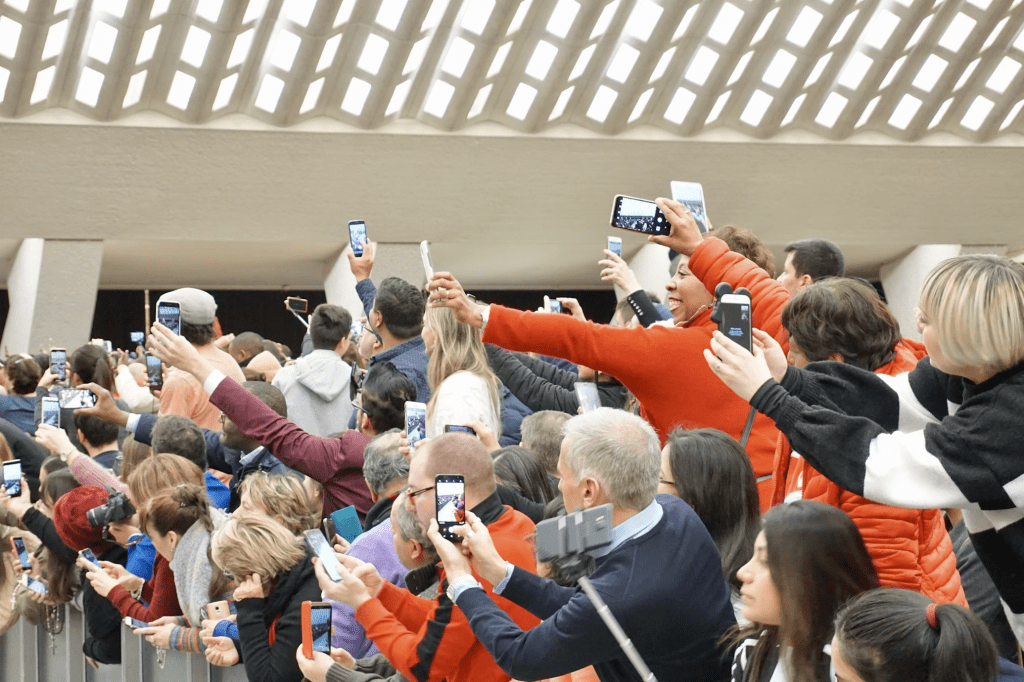
How we shared the experience with others who hadn’t seen that would be very different too. Not only could we tell people in person but using WhatsApp, Instagram, Tiktok, X, or Facebook, for example, and I’m sure there would be countless ‘selfies’ all over social media.

The world has changed almost beyond recognition since Jesus spoke to that crowd (and others). We have so many different means of sharing and spreading the Gospel now, so many more than those people who heard at least some of what Jesus said that day.

Plus we have the advantage of being able to read and think about the things Jesus said and what others, including those who met him and enjoyed close personal relationships with him during his earthly life, said about him.

I’m not a massive fan, or user, of social media but I do enjoy sharing my experiences of faith through this blog, which I started almost four years ago and I’m investigating ways of bringing it to a wider audience.

Image by Renaud Confavreux @ Unsplash.com

We may not have to trek up a hillside and strain to catch his words but we should be working just as hard as his first listeners did to hear the truths behind them and pass them on. Despite changes in technology, the message hasn’t and won’t be changed.

What could, and should, each of us be doing to bring our experiences of Jesus to others?

What could YOU do today?

However Far We Travel …..

I’ve been reading recently about the NASA astronauts who returned to earth after an unexpectedly long stay on the International Space Station. What should have been a stay of one week turned into 286 days for Suni Williams and Butch Wilmore, due to technical problems.

Although space, and science generally, aren’t things I’m interested in particularly, I’m fascinated by the Space Station and have used a NASA phone app to find out when it will be visible as it passes above the UK.

When this happens, if it’s at a reasonable time and on a clear night, I like to try and remember to go outside a few minutes before it’s due and see if I spot it and then watch its progress overhead until it’s disappeared from view. (I might also admit that I sometimes wave like mad as it passes … but you didn’t hear that from me)!

It’s so hard to believe that this small, bright dot travelling so quickly above us is actually an incredibly expensive collection of technological gadgets crewed by humans from many different countries and directed, ultimately, by another group of humans back on earth and their incredible technology.

Last year I went to a wonderful multimedia show in London called The Moonwalkers. Narrated by actor Tom Hanks, this looked back at the story of the Apollo moon missions in the 1960s and 1970s and also looked forward to the Artemis programme of crewed missions to the moon which are due to start in 2026.

Inevitably, the limited technology on view in the shots and films of Mission Control in the 60s and 70s appeared to owe much more to pen, paper and calculators than microchips, quantum computing and artificial intelligence. It seems a miracle that the missions were so successful.

The photos and film taken by the Apollo astronauts on the moon’s surface, many whilst travelling in a Moon Buggy, were remarkable and, shown on massive screens completely surrounding the audience, created a really immersive spectacular.

It seems incredible to me that the total number of people who’ve stood on the moon so far is just twelve and that each visit lasted only days, yet the footprints they left remain and will do so, potentially, for millions of years. The lunar landscape, shown in a much larger scale and higher resolution than we saw in news footage at the time, looks like an extreme example of many people’s idea of a ‘wilderness’ with few landmarks to indicate the way to travel.

Lent, the end of which we’re approaching during Holy Week, is a good time to consider our own times in the wilderness: when our spiritual lives have been hard, dry and confusing; when we’ve felt lost, without recognisable landmarks and without a focus.

When we feel like that, we don’t have to wear cumbersome space suits to protect us as the Apollo astronauts did as we try and make sense of where we are, or wait nine months to be rescued because technology, despite its advances, has failed spectacularly.  

The astronauts on the moon, though in one sense they must have felt so small, lonely and far from home, seemed to enjoy their exploration of the possibilities of the wilderness, jumping and even experimenting with a golf swing. When we feel small, sad, lonely, even abandoned, let’s remember that our return to an awareness of our Lord’s love and protection is always less than a heart beat away. He will always comfort us and guide us through, then away from, the wilderness when we ask Him to.

The one thing we have in common with the astronauts, is that our footprints will remain for untold years. Ours won’t be on the surface of somewhere bleak and lonely though. They’ll be on God’s heart until the end of time.

Whether your Lenten journey so far has been a joy, a struggle or something in between, what a beautiful thought to carry with us through Holy Week and to celebrate at Easter.

Have a Happy and Joyful Easter.

What is Holding Us Up?

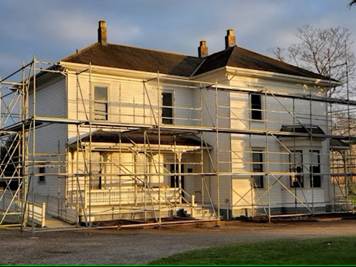
(Image by Gennifer Miller @ Unsplash.com)

A bungalow near where I live has been covered in scaffolding for months while building work has taken place, with extensions to the side, back and into the roof space being added. The scaffolding has helped to shape and support the expansion of the building.

I’m amazed at how much scaffolding has been used for what was a small bungalow. It reaches way above the roof top. It’s there, of course, to support the building and as security for the site workers, allowing them to reach the upper levels safely.

I watched recently a television programme where a film crew went up through the scaffolding on Manchester City Hall, first by lift then via a series of ladders and through a forest of scaffolding poles to reach the area where repairs and refurbishment to the building’s clock were taking place as part of a massive restoration to the whole building. Looking at the huge jigsaw of steel poles and bolts, it became clear why it had taken many weeks to erect the scaffolding before any work could begin.

In other parts of the world timber or plant material such as bamboo may be used to support buildings under construction or repair but whatever is used, the scaffolding is generally something external.

In our lives we all need to have a supporting framework. Often that will be external. I’ve had two operations on one ankle, each involving months in a plaster cast. Though it was very restrictive, I had no choice, so I accepted that the plaster was there to support me, maintaining the shape of my realigned joint and nurturing my recovery.

Sometimes, when life feels a bit shaky or insecure, people are tempted to try all kinds of things to provide external support: addictive substances or habits, possessions or financial security for example. Whatever these may seem to provide in the short term, they reshape us in the wrong way and we’re likely to end up in a much more damaged state.

How much better it is to know that we have the love of God, the love and friendship of Jesus and the presence of the Holy Spirit as internal scaffolding, supporting and shaping our lives. Although we may be more conscious of that truth at some times more than others, the ultimate spiritual support is always available, keeping us steady and, like scaffolding on a building, allowing for continual growth and development.

Even on days when I’m feeling my age and my joints feel rusty, slightly creaky and less flexible than I’d like them to be, I know that my internal scaffolding will give me unfailing strength.

Once the scaffolding is removed from a building project, the bolts and poles are piled onto a truck and driven away for use elsewhere. We get to keep ours! God’s love isn’t just constant. It’s moving endlessly, with us wherever we are and whatever we’re involved in, protecting the shape of us as we are but also outlining new spaces for us to develop into.

Like the builder’s truck, we need to keep moving on, carrying the news of that spiritual support to others, telling them what it means to us and how it can transform their lives, confident that in doing so, our own support will be strengthened.

Let’s reach to the rooftops and beyond!

A Journey to God’s Heart in Prayer

Image by Jermain Ee at Unsplash.com  

Recently I’ve begun making plans with my husband to fly to Italy for a week’s holiday in a few months’ time and we’re now working through all the admin which is involved: passport renewal, travel insurance, transport to the airport, currency, luggage allowance.

Now, a few weeks after booking and inspired by a worship service on the theme of Walking the Way and another where we exchanged names with another person in the congregation to form prayer partnerships for the coming twelve months, I’ve been reflecting on arguably the most remarkable journey anyone can make. One which doesn’t involve flying or indeed any form of transport or even walking (in the physical sense).

Not a ‘once in a lifetime’ journey; not a journey we have to take or are forced to take but one we can choose to take, one which has the potential to become a beautiful, continuous, lifelong and life-changing adventure.

That is, the journey of prayer, leading us from wherever we are at this point in our lives to the heart of God. Wherever we start from, we know that we’ll be journeying in the company of others, even though no two people will be taking the same route. Indeed we’ll be deliberately taking other people with us on many occasions; those we know such as our family, friends, colleagues, carers, neighbours and prayer partners, along with those we don’t know personally but who have been placed on our hearts, for example  people across the world whose faces we see on our screens existing in desperate circumstances who we can carry to God in prayer.

Our holiday preparations have involved computers at home and at the travel agent’s office and we’ve marvelled at how the human designed internet has connected us to so much information and support. How much more we should marvel at our connection to God through prayer, one which doesn’t need for a physical link but using instead the power of the Holy Spirit.

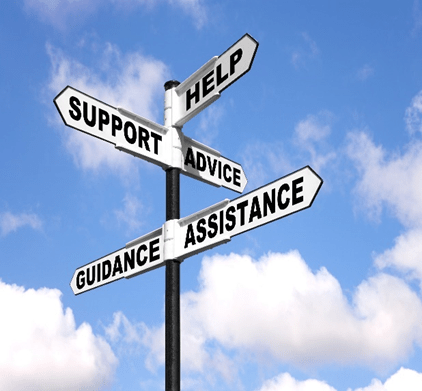
R T Images @ iStockphoto.com

On any journey, some people seem to be able to get to their destination very directly and need few, if any, signposts to follow. So too with prayer journeys we’re likely to have periods when it seems to come easily; when we seem to be able to find the right words at just the right time and may even see tangible results from our prayers quite quickly.

At other times and stages of life though, prayer can seem like a burden, just another thing to be ticked off the endless “to do” list we carry. Even if we know who or what we should be praying for or about, often we can’t always find the right starting point. Or we begin full of good intentions but allow ourselves to be distracted by that noisy notification from our phone which we feel has to be checked instantly, or the demands of family or ill health seem to restrict the time and space we can make for prayer.

We feel lost and disillusioned on our prayer journey. We’re walking in a forest with no clear path ahead or on a path which comes to a junction, where we’re presented with a choice of routes. Or, perhaps, we feel that our load is simply too heavy, the responsibility of carrying the sadnesses of others was well as our own too much to bear.

That’s when we need to acknowledge our need for a companion; someone who can point out the best path for us or, who if we ignore them then press ahead and trip over an obstacle, will gently pick us up, dust us down and make clear the way ahead, laying stepping stones or a trail of footprints on our hearts, without exasperation or judgment but with loving concern. When I’m praying at home, I often sense Jesus sitting alongside me as a concerned friend, listening closely as I open my heart and talk about the things which concern me or which I need help with. He’s the guide who never fails me.

Whenever and wherever I’m praying, I find that every prayer is a journey. A moving from one subject to another, sometimes travelling in straight lines, often doubling back or, occasionally, taking a completely circular route so that I finish back where I started. What an adventure!

Some days I feel guilty that I’m carrying so much ‘baggage’ with me but I need to keep reminding myself that, unlike the baggage I’ll take on my journey to Italy, with God there’s no limit to what I can bring to him; he won’t be overwhelmed, as I am so often.

I know that I can talk in simple language; no special vocabulary is needed. I might sometimes speak fluently but I know too that it’s alright if I don’t. I can pause, struggle to find the exact words I want to use, even repeat myself. I know that, however tentative my words, they’ll be carried by the Holy Spirit straight to God’s heart. What a destination!

At times when I can’t find any words at all, I simply sit in God’s presence, knowing that his Holy Spirit is doing the talking for me. How life changing it is to know that truth.

Of course, on my prayer journeys I have times of great happiness too: celebrating joys and successes, whether other people’s or my own and giving thanks for hopeful signs, however small, in those ongoing stories of tragedy and pain which seem to dominate our news. What a relief it is when the Spirit prompts us to receive God’s happiness.

Whatever prayer journeys you take, whoever and whatever you carry with you, be excited about having the privilege of being on a road which, however convoluted, connects you so powerfully to the heart of God.  

Happy journeying!

What Three Words?

What Three Words?

Recently I overheard someone mentioning the What3words app to a friend. I knew about this app, which has assigned a unique combination of three random words to each three-metre square on the earth’s surface and I have it on my phone.

It’s used by delivery drivers and the emergency services amongst others and, though I wouldn’t describe myself as a great fan of technology, it proved very useful when our heavily laden car broke down as we were returning from holiday a few years ago and we needed to summon a breakdown service.

I decided then to find the words listed for the church I attend regularly. These included ringers (I wonder whether this was an accidental or coincidental reference to the bellringers who signal our Sunday services?), trail, splinters, feared, prepare, conquer and oasis.

This got me thinking about the words we choose to use to define certain parts of our lives. Looking at the words I found for my home reminded me that our homes are places where the people we rely on for personal support may live (or have lived) with us, where we share things with one another and help each other navigate life’s difficulties.

Looking at the words for the church, I felt some connection with all of them. We may feel that what lies ahead for us on the trail we’re following through life is something to be feared and we feel that we must take things into our own hands and prepare for the journey in our own strength. We can cope with all the splinters, can’t we?

When I look at the final two words in the list, conqueror and oasis, I feel confident that if we rely on Jesus for our strength we can conquer (or overcome) the obstacles we find on our route and, that we will find rest in the calm oasis of Jesus’s love and friendship.

**************************************************************

Though I’ve made a few edits susequently, the previous seven paragraphs were written in early October, since when I haven’t had time to write for pleasure because of another three words which have dominated my year: Christmas, Tree and Festival. In late January, I offered to organise such a Festival for my church in Ditchling, Sussex. Though I have been involved in the planning of large (and some larger) projects before, I was the lead on this, which was challenging though also very exciting. I’ve loved Christmas trees since childhood and so it was a dream project for me.

Plans developed slowly across the early months but from October, it became a full-time job almost. I faced many frustrations, including navigating a new computer and coping with almost continual health issues. It was, however, deeply rewarding.

I don’t think that an event qualifies for a listing on the ‘What Three Words’ app but I’ve decided to choose three anyway and they are Faith, Hope and Love, all of which I’ve experienced over the past weeks.

Firstly, I needed to have faith that I could organise and deliver the event in a professional way. Secondly, I had to hope that people would come to visit the Festival and that they would take away some good memories, both of the event itself and the atmosphere it created within the church and the community.

Finally, but most importantly, as we’re told in 1 Corinthians 13: 13., was love. This could be seen so clearly in the companionship of people who decorated trees for the Festival, visitors and volunteer helpers. The atmosphere of warmth, mutual assistance, appreciation of one another’s creativity, learning from each other and the buzz created on local social media was a joy to be part of.

As Christmas approaches, the words people will use to describe their festivities will vary. Some will say excitement, presents and food. Or family, friends and fellowship. Unfortunately, others might have to use loneliness, sadness and despair and they need our prayers to give them the faith, hope and love. they need.

What Three Words might you choose to adopt this Christmas?

A Happy and Blessed Christmas to everyone, wherever you are.

Bridging the Gap

Image from iStock

I’m not one of the people who likes to watch endless videos of animals doing amusing things on Facebook. I know that if I got drawn into doing that regularly, that I’d waste far too much time. However, recently I spent several minutes watching film of a panda trying to move from one structure in its enclosure to another without falling down the gap between them.

Much I hate to admit it, watching it was fascinating. The panda managed to get first one and then the second of its front paws planted firmly onto the surface it was trying to reach (which was at a lower level than the one it was starting from).  However, when it tried to move a back paw to join them, it realised that this would leave it dangerously unstable. 

At this point the animal was spread-eagled across the void between the two pieces of climbing apparatus and seemed to be stuck. It then tried to rock its weight back and get one of its front paws back to where it had come from but realised that this wouldn’t help its forward transfer, so it had another attempt at crossing the gap.

As this didn’t work, the panda tried returning one paw, then when that didn’t work, the other back paw, to where it had come from. It did manage eventually to anchor itself by one paw safely onto the first structure and the footage ended with the animal climbing down the wooden frame, presumably to cross the ground and climb onto its preferred new perch from there.  Little did it know that it would have, in time to come, a worldwide audience thanks to the reach of Facebook!

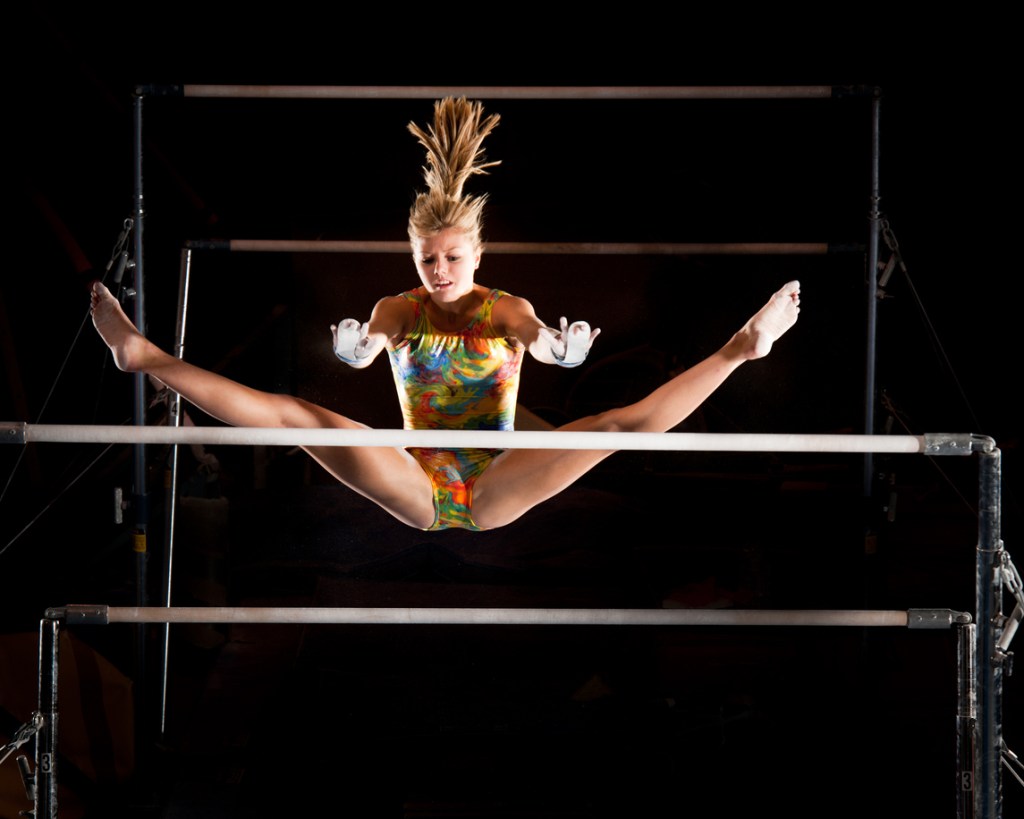
As I write, the Olympic Games are underway in Paris and I’ve been watching some of the gymnastics competitions. As I admire the skill of those competing, I wonder how many times they fell from pieces of equipment when they first took up the sport, long before they’d perfected their technique.

Watching them now even with their years of training and experience can be quite nerve racking, perhaps particularly so when they compete on the asymmetric bars. I can’t imagine how much courage it must take to throw yourself upwards and backwards from the high bar without being able to see a landing point, then snatch at the lower bar and be ready immediately to rotate into a perfect handstand.

How often do we feel we’re being thrown around by life with very little to cling onto? How difficult it can be in the middle of a crisis to identify anything which might be an anchor point. If we do spot one, do we always have the courage to reach out towards it and how secure will it be? Will it hold our weight and the weight of all we carry with us from day to day? How often do we, like the panda I watched, over reach ourselves and then have to perform what feels like a humiliating climbdown?

Growing spiritually, for me, is a process of catching hold of something to which I feel I’ve been led: sometimes clinging onto it tightly until my confidence grows and then, sometimes having to let it go and reach towards something else. I may not be able to see the ‘something else’ very clearly and I might feel like the gymnast on those asymmetric bars, or even the panda straddling the void but I’m sure of Jesus as my anchor point.

I know that I’m loved, held and supported by Jesus and that even though I began my journey of faith comparatively late in life and without the years of practice that others have had, I will be given everything I need to face whatever obstacles lay ahead and will be able to move from one to another at the right time and at the right pace, even if that involves moving in some unexpected directions.

I may not do that as elegantly as the gymnasts in Paris do but I have confidence that I’m slightly nearer the podium than that poor panda!

Following the Posts Which Matter Most

Image by Annie Vo @ Unsplash.com

How do you remember things you need to do? When you’re in the middle of one task and an idea comes into your head or you remember that you’ve got to buy and send a birthday card or gift within the next few days, what do you do?

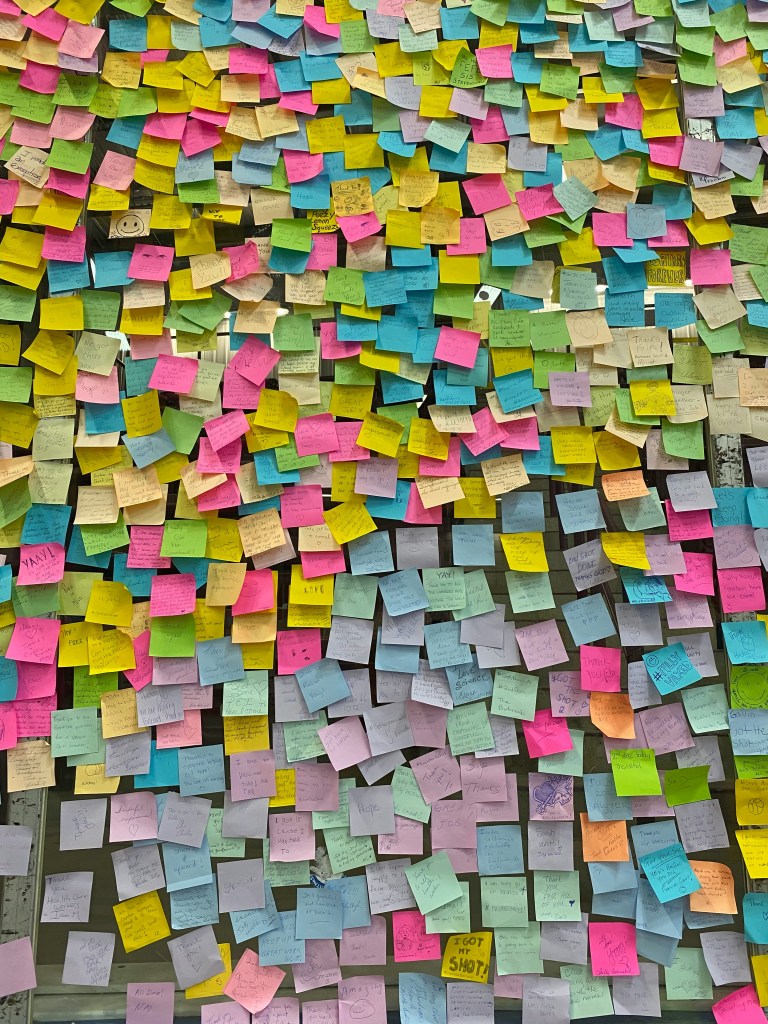
I often use Post It Notes (Sticky Notes) which I can peel easily from their stack on my desk and fix to the desk surface, a piece of paper, a wall or shelf. You can get an electronic equivalent too on your computer or phone screen though I’ve not tried that.

I haven’t got to the stage of using different coloured notes for different topics yet. Unfortunately, as I’ve got older, it’s usually been a case of grabbing the top sticky note from the nearest stack before the thing I need to remember or that  ‘amazing’ idea flies out of the other side of my brain before I’ve been able to grasp and anchor it.  

Sometimes, when my brain and the surface of my desk get too full of new ideas, reminders of things I must do and people I must contact, I find myself ignoring them. There’s just too much to cope with and I’m overwhelmed, even resentful that I’ve got so much to do; even though it’s, more often than not, my own fault for arranging and taking on too much.

But the Post It notes I always try to pay attention to/prioritise are those ones which I can’t see physically: the spiritual Post It notes.

I return often to the Bible story of Martha and Mary’s reactions to Jesus when, as their friend, he visited them: Martha rushed around getting exhausted and resentful, while Mary sat with Jesus, simply listening and learning. This brings me back to the realisation that it’s not what I try (and often fail) to do for God but how I am with God which matters.

A helpful spiritual Post It note reminds me to listen to the daily reflection from Pray As You Go https://pray-as-you-go.org/ which provides a lovely framework for prayer and contemplation. It’s what I do each morning before I check emails and messages and start on the day’s tasks.

Then, as I go through the day, I find it’s helpful to turn away from all the Post Its on my desk or keyboard from time to time and sense the spiritual Post Its. When I go to my Home Page on the internet, is there a ‘breaking’ news story which I could be praying about?

Is God prompting me to stop, take some time away from the computer and go outside not only to get some fresh air and clear my head but also to experience the wonder of His creation?  

On days when I’m super busy I’m sometimes prompted to take a few moments to quietly ‘be’ in God’s presence, absorbing the simple truth that I am loved and blessed however active, or inactive, I may feel that I’m being.

Among the plethora of notes and reminders written on a variety of coloured sticky notes with a variety of different coloured pens with which I’m surrounded, (and I have been known to get up during the night and add to the piles!), the ‘spiritual’ reminders aren’t always obvious. Yet, they’re the most important.  I’m practising becoming ever more conscious of them and reaping the benefits.

Think about your own reminders. What do you need to be reminded of today, this week, this month or for the rest of this year? Keep as many lists, diaries and calendars as you need to, physical, mental or electronic. But don’t forget the spiritual prompts reminding you to connect with God.

Now, not having written a blog post for a few months, I can remove the Post It note stuck to my computer keyboard as a prompt to write one. That’s one down only another ten or so, in various colours to go, and my desk will be clear!

Turning Down the Colours of Holy Week

Image by Duncan 1890 @ istockphoto.com

One of my favourite “coffee table” books is the catalogue of a 1990s exhibition of photos taken by some of the people who, in the 1940s, established Magnum Photos as a collective of photojournalists. Still in existence today, its archive includes many of the most iconic images of the intervening years.

Almost all of the photos in the book are in black and white and that is what I love about them. There is something about a photo, picture, or a drawing which, with the colour stripped from it, captures the essence of its subject and its setting.

The tiniest details which, in a coloured image, might get lost amongst a mass of other shades and shadows become easier to see somehow when the picture is in monochrome. Everything, despite the lack of colour seems more vivid. We’re forced to look more closely at the image as we make choices about out what is most important and what our reactions to that are.

I’ve found this to be true especially of textures: for example, the lines or scars on someone’s skin, or the folds of a garment.

The paintings we’re used to seeing which show the events of Holy Week are in colour generally and, though frequently sad and hard to look at, very beautiful.

I’m a great fan of the Ignatian practice of putting myself into the scene when reading about events in the Bible. This Holy Week I’ve found myself imagining the various familiar scenes stripped of all their layers of colour. So, in what I’m seeing around me, I’m not distracted by the colours of peoples’ clothes or of the buildings or the landscape etc. Instead, by concentrating on the textures of things and how they would feel to me if I could touch them, everything seems very raw and I experience things at a simpler and more intuitive level.

In just thinking about some of the scenes of Palm Sunday and Holy Week: I’ve ‘felt’ the tough hairiness of the colt’s back on which Jesus was sitting as he entered Jerusalem; the clouds of dust created by the frightened birds and animals and the coins rolling around in the temple precincts as Jesus drove out the merchants; the viscosity of the perfumed oil with which Jesus’ feet were anointed; the roughness of the earthenware platters and vessels and the rustic bread he broke to share with his disciples and the dry, perhaps stony, ground on which Jesus knelt to pray in the Garden of Gethsemane. I’ve felt, in both an emotional and physical sense that I’m in those scenes as I’ve read or heard them read.

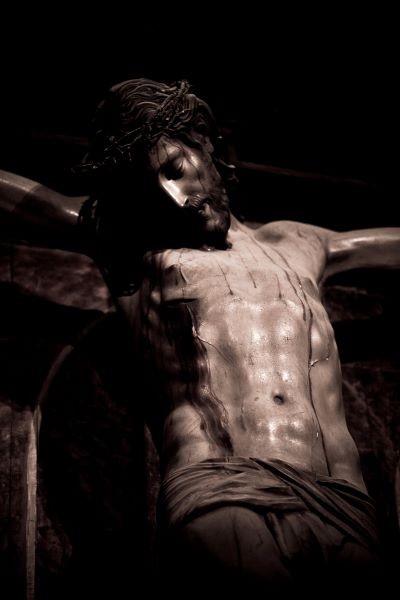
It’s easy to picture in black and white Jesus struggling to walk his broken body to Calvary, because of the sadness of that journey. Everything seems to be very grey at this point with little or no prospect of light returning. Yet, against this, my attention is drawn to the things which do stand out: the cross, back breaking in its solidity though rough-hewn and splintered, and the spiky crown of thorns. The thought of how these things would have felt in this context is both chilling, yet strangely reassuring. A heavy piece of wood and some prickly thorns are something I can imagine trying and failing to hold onto.

As Jesus goes through his long, agonising crucifixion, the lines of pain etching deeper into his face and the faces of his followers as time moves on, and the drops of black staining the monochrome dust beneath the cross with his blood show, far more clearly than colour would, the humanity of his suffering and draw me closer to this terrible scene.

Today, Maundy Thursday, the darkness at the entrance to his tomb leading to a bright angelic presence and the good news that Jesus has risen, await us on Easter Sunday. It seems right then that the images and stories revert to full, glorious colour.

I’ve found it really helpful to ‘go back to basics’ this Holy Week and to reach out and touch, through my imagination, at least some of the things Jesus touched during the final part of his human life and, by touching, draw closer to him, who has reached out and touched me and continues to do so.

Why not try this out yourself, particularly if you enjoy stripping things back to basics? Have a happy and blessed Easter.

The Bridge of Prayer

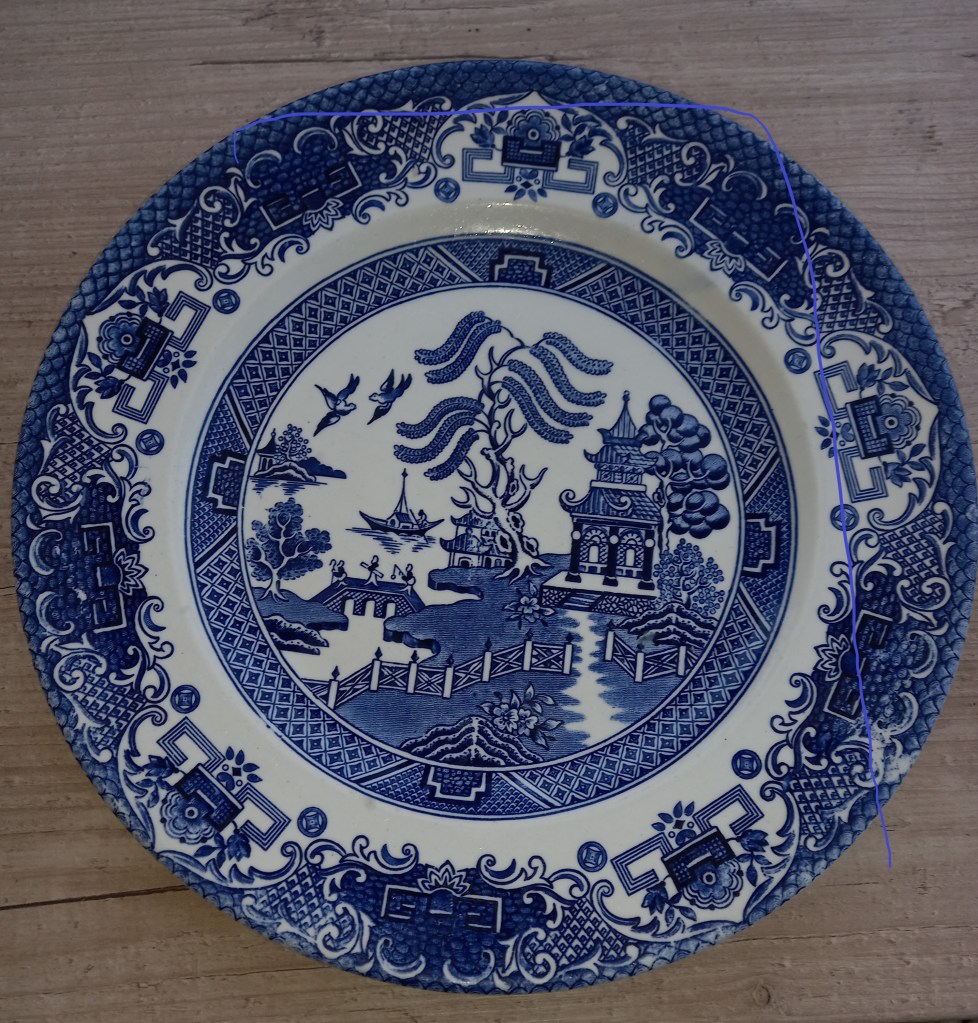
I’m fortunate enough to own a beautiful bone china coffee service: it’s almost 100 years old and though it’s too fragile to use, seeing it every day gives me great pleasure.  The next oldest item of china I’ve got is a plate decorated with the famous Willow Pattern, which I found abandoned on a kitchen shelf when we moved into a previous home over forty years ago.

It’s an ‘everyday’ plate which must have been quite cheap to buy. It may be the only remnant of a tea set; I will never know. I’m surprised simply at how long it’s stayed intact, as my husband has eaten his sandwich lunch from it on most days for over forty years.

I wash up and put away the plate every day with barely a glance. However, I did stop and look at it more closely recently and was struck by the image of the small bridge leading from the left of the main part of the scene towards another place which is almost out of sight.

In the fairy story which inspired the pattern, Koong-Se and Chang, a young couple whose marriage has been forbidden, escape over a bridge but are followed subsequently and killed and then immortalised in the form of the doves seen flying over the scene.

This got me thinking about the reasons why we have bridges and how they can be considered in the context of prayer.

Bridges are built in straight lines generally, with strong supporting pillars and, often, anchor points at either end. Many remain standing centuries after they were built. For example, the bridge at Postbridge on Dartmoor in Devon, built in mediaeval times for pack horses to carry tin from local mines to the town of Tavistock. Some cross water, carrying road or rail traffic above rivers or harbours to connect places and communities.

Often a bridge is the shortest and most direct route between two places and when a bridge is destroyed, whether during a conflict or because of a natural disaster such as flooding, the journey between the places which have become separated can be a time-consuming and frustrating process.

Prayer is a bridge between us and God, not dividing us but linking us. However challenging prayer can be at times, and it can sometimes feel as though we’re crossing very choppy waters, prayer carries us safely to the heart of God. 

The prayer bridge is always open and there’s no toll to pay before we’re allowed to cross. Jesus paid that toll for us on his cross.

Another bonus is that prayer isn’t restricted to a particular time or place. We can pray anywhere and everywhere: in formal settings such as during a church service or while walking round the supermarket or around local streets with a dog, for example.

I’ve had some really good prayer times when I’ve prayed aloud quietly under my breath whilst driving, though with the current state of many of our roads, I will only do this on roads that I know very well, at times when traffic levels are low and during the daytime so that I can remember (usually!) where all the potholes are.

Walking around our gardens or across the countryside on a sunny day is a beautiful setting for prayer too of course and prayer can come very easily and naturally then. These are the times when the bridge of prayer is crossing calm waters.

Sometimes though, we go through turbulent, challenging, even dangerous times in our personal lives when it’s hard to see a clear way forward. We have to cross some choppy waters. That’s when our bridge of prayer, however weak and wobbly and like a personal Bridge of Sighs it feels, is at its strongest, withstanding the most agonised outpouring of pain and doubt and anchoring us to the firmest of foundations.

We can build bridges for other people too. As we lift them to God and ask that he will carry them safely from one side of a difficult situation, via our prayer bridge, to an acceptance or resolution of the things which are troubling them, they may be encouraged to repair, maintain, strengthen, or even build for the first time their own bridge to God’s heart.  

Yes, we all need to maintain our prayer bridges carefully: that work continues throughout our lives. However many times the ground beneath our feet feels unsteady and however often we feel in fear of being swept away, unlike Koong-Se and Chang in the story told by the Willow Pattern, we know that at the end of our lives our prayers will be answered as we cross that final bridge to reach a place of complete safety with God.

Covering bridges with padlocks to symbolise love between people is common in many places, though the padlocks will rust eventually. Bridges built with prayer aren’t visible, though their effects may be, and if we look after them, they won’t fail. What maintenance does your bridge need today and whose lives might you padlock to it in love?

Where Should We Keep the Greatest Gift?

As we get towards the end of Christmas week, even though we may have more festivities, whether New Year’s Eve parties or simply meeting with friends over the coming days to look forward to, thoughts begin to turn to the end of next week when many people will be taking down their festive decorations and packing them away for another year.

I don’t know about you but I find that time quite difficult. I’ve been affected by Seasonal Affective Disorder (SAD) for some years and I find the lack of daylight during the winter months can cause depression.

One of the ways in which I combat it, is to look forward to December, when so many homes have light displays in their gardens as well as indoors and, in particular, to decorating our Christmas tree. I make sure there are lots of lights on it as well as over one hundred and twenty gold-coloured baubles and other decorations, to bounce the light around.

However, the removal of the decorations and the tree coincides with the removal of exterior lights too: the insides and outsides of homes will be much darker over the coming weeks. Though I haven’t been affected by SAD this winter nearly as much as in recent years, I know that the next month might prove to be a challenging time in that respect.

When I take the Christmas tree down, one thing which frustrates me every year is that however slowly and carefully I think I’m doing it, I find that, inevitably, once all the storage boxes have been filled and shut away in the loft, as the tree is taken outside, I’ll find one decoration or trim left on it. Hidden away deep in the branches will be one tiny bauble which I’ve overlooked.

Then I have to decide what to do about that. Should I go back into the loft and find a ‘safe’ place for that bauble to rest in or could I find somewhere else for it? Somewhere that, right now, seems accessible but which I know I’ll forget about before next December? Perhaps somewhere where I’ll come across it regularly, even though it might seem out of place during the rest of the year? Where should that tiny, insignificant remnant of Christmas stay during the next twelve months?

Yet, by far the most important post-Christmas decision I need to make as the decorations come down and the lights start to fade, is where I’m going to keep the smallest, yet also the greatest, gift of the season: the born-as-a-baby Jesus.

Will he be forgotten and stay hidden and overlooked among the other branches of my life? Or, when I notice him as I prepare for the tasks and challenges of 2024, will I put him in a safe but remote ‘lofty’ place to be checked on occasionally when I happen to be in that space? Or will I give him a more accessible space where he might be easily noticed but could be ignored just as easily?

No, I’m going to pick up and carry that tiny, shiny bauble, that greatest gift of Jesus’s love, with me, within me, every day of the new year and all my years. I pray that it will grow and shine out to be shared with other people, lightening their dark times too.

If you find one bauble or decoration left when you think you’ve packed them all away, think of it as a reminder that the light of Christmas, the light of the world, Jesus is with us always, whether we feel him very close to us or whether he seems to be packed away somewhere for a time. He will always come back to remind us that he’s with us still.

May we each carry his light be with us as we go into the new year.

Thank you for reading my blog during 2023 and I look forward to sharing more thoughts with you in 2024.

Sherrian

Unexpected Items in Bagging Area?

Picture from Why Frame Studio

As our supermarkets get busier at this time of year, if we’re shopping in person the queues to pay for our goods get longer, inevitably. Few people remember a time when there were no queues in the run up to Christmas but how the queues and payment systems operate has, of course, changed over time.

Some years ago, people queued to have their shopping itemised manually, the cashier pressing buttons on a cash register. Payment was made with cash or a cheque.

Then bar codes appeared on products and scanning machines were installed at tills to speed up the check-out process. Cashiers still operate many of the tills but, as the scanner is responsible for checking and entering prices, it’s possible still to have a chat with the cashier. For some customers, that quick chat may be the only conversation they have all day

Today, more and more supermarkets are decreasing the number of staffed tills and enlarging the area for self-scanning check out tills. No doubt this helps them rationalise numbers of staff and how they’re being used. Yet, as more and more people are encouraged to, or are choosing, to use them, it doesn’t seem to help with the queues, particularly at this time of year.

Nor does it help those who value talking to the cashier. Indeed, one supermarket recently removed all of its self-service tills in response to customer requests.

I do like to talk to someone as I’m packing my shopping so I came late to self-scanning but I usually use if I’ve got a small number of things in a basket to pay for. However, I don’t think I’ve managed to pack and pay for my shopping more than two or three times without having to summon help, usually because of an ‘unexpected item in the bagging area’ or because I’ve got confused (yet again) about where the supermarket’s basket should go and where my shopping bags should go.

It’s very frustrating but with the slight advantage that I do get to speak to someone, albeit briefly, when they come and wave their magic electronic card over things and restore order (at least until I try to scan the next item)!

We’ve just entered the season of Advent, a time of waiting, reflection, prayer and self-examination leading to repentance, as we prepare for the coming of Jesus, both during the Christmas season and his second coming.

How do I feel about carrying out a self-scan as I move into Advent? What in the basket of actions, ideas, emotions and sins that I’ve collected this year am I happy to have scanned by God and which do I wish I could hide? What do I need to add to my basket before I feel confident enough to start scanning?

Fortunately, I don’t make those decisions alone. There’s another very real presence, that of the Holy Spirit, with me as I review my life.

There’s no pressure to rush, no queue of tutting people behind me and no one to tell me that I’ve put things in the wrong places. I can lay everything out before the Lord and wait for Him to show me the right bag to put things into.

Which things do I spend too much time on? Is that because they seem the easiest to me? Perhaps I’ll be guided to put them into a bag which I need dip into only when I’ve worked on other tasks which are more important to Him.

Which things need to go into the bag I’ll carry closest to me going forward? I need to consider prayerfully and then be led into staying with those tasks, ideas, even dreams perhaps, which will nurture me on my Christian journey.

Finally, what about those unexplained items in the bagging area? The things which seem to have crept in but which are causing, and may continue to cause, problems? They’ll be gently scanned: no loud electronic noises or flashing messages here. Instead, the Lord will deal with them patiently and gently and place them into the position in my life where He’s intended them to be all along.

Advent has only just begun but I’m finding it a time of great spiritual refreshment and renewal, inspired and challenged as I am the Advent book An Advent Manifesto by Martyn Percy, (pub. Bible Reading Fellowship 2023; ISBN 978 1 80039 094 2).

I’m enjoying many new insights into this familiar season and praying that you, too, will find the self-scanning process rewarding. Especially as it can be done in your own home and whether accompanied by seasonal music or no music, at least you won’t have to cope with the supermarket’s dreaded Muzak!

The Only Way to Go

Image by John Schnobrich @ Unsplash.com

Recently a friend was telling me about her mother-in-law’s first experience of being in a car when a satnav was working. In her mid-eighties at the time, Margaret seemed fascinated by the disembodied voice coming into the car giving very specific directions to the driver, her son, who was obeying every twist and turn of the route.

At the end of the journey, she remarked to my friend, “that must be a very busy office that woman is in. She has to give different directions to so many people at once.”

It’s a funny, true story and it got me thinking about how much we depend on our electronic route planners to get us to where we need to be. We’ve come to rely so much on that disembodied voice in our cars, haven’t we?

I find that following a satnav can be quite frustrating at times. If ‘she’ or ‘he’ says “take the next turning on the left” and I find there’s a left turning while the voice is still halfway through the direction, I’m never sure whether to take that turning or wait till I get to the next one which I can see only a short distance ahead. Why can’t it be made clearer?

Also, when I get to the end of my journey, I get very annoyed with ‘the voice’ which, as soon as I’ve entered the postcode of my destination, repeats endlessly, “you have arrived at your destination” while I’m still looking for the exact building I need or circling a busy car park looking for a parking space. I’ve been known to share some quite lively discussions, not conducted always in my quietest or calmest voice, with the unseen lady or man ‘in the office’ at that point!

Since the arrival of satnav many of us have become lazy and no longer use, or even have, books of road maps. I think that’s such a shame. I love looking at maps, planning a route and seeing what well known topographical or historical features I might be going to pass.

But whether we prefer to use maps or to rely on satnav, we all like to feel that we’re moving in the right direction and (mostly) we appreciate anything which will help us get to where we’re going. We like to think we know best, that we should be the one making the decisions about whether we continue on the route we’re on, whether we need to take a detour or whether we need to retrace our steps.

Of course, we all have recourse to a personal satnav in Jesus. A satnav which will always have the right route for us but will never impose, waiting patiently until we realise that we’ve taken, or are about a take, a wrong turn or simply chosen a path which will lead us through confusion, disappointment, even pain.

We resist using that satnav so often. We don’t like to hand over control. We want to be in charge of our own lives, even when we know from experience the problems that may cause. We don’t welcome what we see as interference in the way we organise our lives.

However, when we look back on how far we’ve come and what we’ve seen and experienced on the way to where we are now, it’s like looking at a beautiful map. We can see the lie of the land and relive both the memorable high points and the inevitable lows which we’d rather forget. It’s the map of our lives, drawn before we existed, with a clearly marked route from beginning to end.

Yes, the detours we take when left to our own devices may seem tempting, even exciting but we really need to listen to that ‘man in the office.’ The man who is able to give different directions to so many people all at once.

Through the Bible we have a physical atlas to help us with our journey through life and through sensing and knowing the presence of Jesus with us we have the perfect satnav. We just have to learn to keep quiet often enough to hear what’s being said!

Whatever you’re navigating in your life at the moment I pray that you’ll make time to check in with Jesus, your spiritual satnav regularly. Like my friend’s mother-in-law, we don’t understand how he does it but, if we trust him, we know that we’ll arrive safely.

From a Flicker to a Flame

Recently we suffered a power cut at home, just as I was looking forward to my morning coffee, Fortunately, the power was restored within half an hour and, as it was daylight, I didn’t need to search for candles.

Photo by Rebecca Peterson-Hall @ Unsplash.com

How much we depend on light; how often we take it for granted. The first thing we do when we go into a darkened room, is put the light on. We spend money on different kinds of lighting for different rooms or tasks in our homes and, sometimes, for our gardens too.

Power cuts usually arrive without warning and it’s a shock to be disconnected from the power which sustains so much of our lives. One of the most unnerving experiences I’ve had was while on holiday, driving along a winding country road at night.

I went from seeing the road ahead to being in total darkness as the car’s headlights failed suddenly and, fortunately, temporarily. A different power source in that case but the same sense of disorientation.

In our spiritual lives, there are times when we feel we’re bathing in Jesus’s light. It’s so clear, coming from above, around and within us. We feel so closely connected to Him. What a wonderful feeling. Not only is it comforting and supportive but it’s lighting up the path ahead so we see very clearly the way we should be going.

Sometimes though, we can suffer a spiritual power cut. It might be triggered by a specific event or it might come on gradually, caused by depression, doubt, anxiety, or low self-worth, for example.

The light which had surrounded us seems to have been extinguished and we can’t move forwards, or go back to where we were. When that happens, it might take some time to be reconnected. Will God’s repair be the personal equivalent of replacing a fuse or will we need a more fundamental rewiring?

Whichever it is, God will work gently, doing exactly what is needed to restore us to full relationship with him. Our connection to him is never truly broken. However deep the darkness, there’s always a candle flickering, gently but persistently in us.

We sometimes need to search really hard to find it and we might feel bereft, but darkness is just the temporary absence of light and the candle of Jesus’s love for us burns constantly, guiding us through the darkness towards a renewed sensing of his love. In time that flicker will become a steady flame burning in us again and shining out to others.

Everyone is called to carry Jesus’s light to other people. Even if our own candle is flickering a bit at the moment, don’t let’s forget times when we’ve been to candlelit carol services where a flickering candle can still light another one, which lights another one and so on, until we’ve created the most beautifully lit space.

So, let’s spread the light now, trust in Jesus to deal with any current or future spiritual power cuts and …. if you haven’t had your morning coffee yet, I pray that the power will stay on at least until you have!

Disappointment

I started drafting this post on the day that GCSE results for 16-year-old students were published in England, Wales and Northern Ireland.

Following the disruption caused by the Covid pandemic, which saw teaching moved online and otherwise disrupted, and the adjustment made to grades for the past two years to take account of that, there was much discussion on how this year’s students would fare.

Fortunately, once the results were published, it seems that many of the concerns about grades proved to be untrue but there will have been some students who didn’t get the grades they expected and so may have been disappointed as they move onto the next stage of their life, whether in education or outside it.

Disappointment is a strange emotion which, I think, is sometimes heightened because we have our own (often very fixed) ideas on what the outcome of a situation will be.

Sometimes disappointment comes through events, when we try to repeat something which has worked well, or which we’ve enjoyed before, expecting the result to be identical.

When I was a child, my family holidayed in Guernsey in the Channel Islands in three consecutive years. We had breakfast and an evening meal at the guest house where we stayed and bought bread, cheese and fruit from the market for a picnic lunch on our favourite beach.

During the second holiday, to vary things, we decided to visit the very basic looking café above the beach at lunchtime and buy and eat some sandwiches there. It was very busy and while waiting to be served, we saw plates piled with such delicious looking food coming from the kitchen that we decided to have a full meal instead of sandwiches.

Although that was over half a century ago, I can remember so clearly what we ate between us: two huge plates of fish and chips and two wonderfully fresh crab salads followed by raspberries with thick, yellow Channel Islands cream and, for my brother, a banana split which had not only a banana and ice cream but also the same sized portion of raspberries and cream as the rest of us were enjoying. He certainly made the best choice!

We talked about that lunch for months afterwards and on our holiday the following year we couldn’t wait to go back to that cafe. We could almost taste the banana splits which, that year, we were all going to order!

Imagine our disappointment when we pushed the door open to find a very dusty, uncared for and half empty café which had obviously changed hands. Deciding not to waste precious holiday funds on a full meal, we made do with some very dry and unappetising sandwiches. Probably the most disappointing meal I’ve ever had. Doing the same thing twice and expecting exactly the same result so often leads to disappointment.

Sometimes we’re disappointed not by situations but by people. This may be in small ways: they might forget to send a card for an important birthday or anniversary; they leave it until the last minute to let us know that they can’t come for the meal we’ve spent all day cooking or, they arrive later than expected when the meal is past its best.

Or, sometimes, in larger ways: a relationship in which we’ve invested so much emotional energy may end abruptly; the people living in that house we thought would be our ‘forever’ home have accepted someone else’s offer; our potential new boss has given that dream job to another candidate or our favourite sports team has lost an important fixture…. I know you’ll have our own list.

Perhaps there are things you had hoped would be happening at this point in your life or in the immediate future and you’ve recently begun to feel as though they won’t; or at least not in the way that you thought or, perhaps, not in the place where you thought they would? You may be having to let go of dreams and ambitions through curtailment or adjustment or, even, abandoning them completely like a balloon which has collapsed.

Photo by Nathan Dumlao @ Unsplash.com

How disappointing that feels, with its potential effects on our self-worth and, perhaps, even causing depression. There are times too, when we feel that we’ve failed one another, ourselves and, most importantly, God and that is the ultimate disappointment.

I sometimes think about how Jesus, who was fully human as well as fully God during his earthly ministry, experienced disappointment. Was he disappointed by the way so many people rejected his message? Was he disappointed that his disciples asked repeatedly for clarification? How disappointed was he, (as a human), that his disciples fled and, Peter rejected him when he was captured, tried and crucified even though that had to happen for our salvation? Was he simply disappointed that he had to be away from his family for much of the time without the many convenient ways of keeping in touch which we have today?

It seems that Jesus forgave those who had ‘disappointed’ him and used the experience to teach them of God’s love for them.

As the summer holiday period comes to an end and the hours of daylight are becoming shorter, I’m struggling to find a way through my current disappointments. Yet, I’m trying to use this as a time of learning and growing; resting and waiting to see what’s going to happen next for me.

I’m trusting in God, so whatever and wherever that may be, I know that I won’t be disappointed.